



Omission or Commission?
Medication Errors Still Lead in Preventable Harm Events

Gerryann Whalen, MLS, RN, CPHRM, OC,
Senior Risk Management Consultant
Gerryann began her career as an RN in pediatric oncology. She has over 20 years’ clinical management experience in acute care, LTC, homecare, and ambulatory care. Prior to joining PRA, Gerryann was the regional director of risk management with oversight of patient safety/clinical risk, claims, and colleague safety/WC. She has a Graduate Certificate in Health and Hospital Law from Seton Hall Law School, a BS in English and Business from SUNY Plattsburgh, and an AAS in Nursing from Maria College.
Introduction
Medication errors remain among the most common, preventable patient harm events, due to organizational issues, technological factors, and communication breakdowns.1,2 According to the Institute of Medicine, an error in healthcare is “the failure of a planned action to be completed as intended ... or the use of a wrong plan to achieve an aim.”3 A medication error is “any error occurring in the medication use process,” including problems with the delivery of a medication to a patient.3 The SafeCare study results, published In 2023, showed that medication-related errors vary by setting, accounting for 39% of all inpatient adverse events and nearly 4.5% of harm events in outpatient visits.4
More specifically, medication errors fall into two main categories—acts of omission and acts of commission. An omission error is a failure to carry out an intended action or to recognize that an action should have been done. A commission error is performing an incorrect action or improperly performing an intended action. Errors of omission include not prescribing an indicated medication, failing to recognize a contraindication or drug reaction, forgetting to give a medication that was due, or not ordering required monitoring. Medication commission errors include entering or administering an order for the wrong patient, prescribing the wrong dose, or infusing the medication at the wrong rate.
Most medication errors are avoidable and result from faulty systems, not reckless behavior.5 Although these errors can cause patient harm, many—called “good catches” or “near misses”—never reach the patient. The most common physician medication errors are prescribing errors,6 while pharmacists and nursing staff, by nature of their roles, commit more dispensing and administration errors. Medication errors occur when ”weak medication systems and/or human factors such as fatigue of personnel, poor working conditions, workflow interruptions or staff shortages affect prescribing, transcribing, dispensing, administration and monitoring practices, which can then result in severe harm, disability and even death.”5
Polypharmacy, the concurrent use of five or more medications, can result in errors of omission, such as failing to recognize medication contraindications, interactions, or drug reactions. The American Medical Association’s policy guidelines on medication errors encourage physicians to “evaluate and optimize patient response to drug therapy by appropriately monitoring clinical signs and symptoms ... and periodically reevaluate the need for continued drug therapy.”7 In other words, consider adding medication reconciliation and reduction to your standard practice to decrease polypharmacy.
Of particular concern is polypharmacy in elderly patients. Many older adults have multiple comorbidities. These adults can have adverse reactions to medications at usual doses, due to age-related changes in drug absorption, distribution, and metabolism.8 Older adults can have unwanted adverse effects intensified when taking multiple medications, caused by the medications’ synergistic effects, potentially causing drug events not seen when taking a medication by itself. Complications of polypharmacy include delirium, falls, and hip fractures—all preventable hospitalizations that can lead to long-term care placements and increased healthcare costs. Polypharmacy presents significant concerns for the healthcare system and its patients. Judicious prescribing and taking steps to discontinue medications that may be causing more harm than benefit can improve health outcomes and decrease costs. The Centers for Medicare and Medicaid Services (CMS) estimates polypharmacy costs around $50 billion annually.9
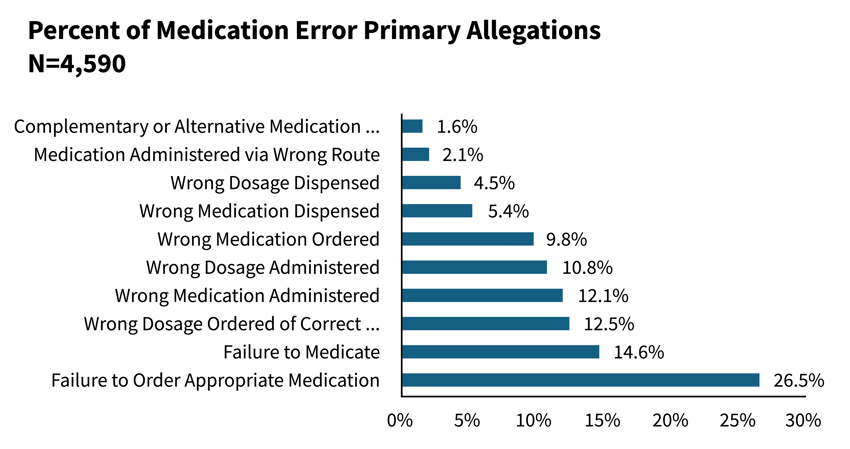
Missing any one of the basic five rights (5 Rs) of safe medication administration (right patient, right medication, right dose/rate, right route, right time) can lead to a medication error. Completing the 5 Rs is not enough, though, to reduce medication errors or patient harm. Every medical error should be investigated with a focus on identifying system defects, not individual failures. When a medication error occurs, it is more important to question what, how, and why the system went wrong than who was involved.10 In the graph below, the top three allegations include failure to order appropriate medication, failure to medicate, and wrong dose ordered of the correct medication. Though a recent study from Candello, revealed the majority of medication-related claims result from failures in monitoring and managing medications after they have been prescribed.10


- Use Computerized Physician Order Entry (CPOE). Electronic prescribing systems can alert physicians to potential dosage issues, drug interactions, and patient allergies, significantly reducing errors caused by illegible handwriting, unclear abbreviations, or miscommunication.
- Do not override or disable medication alerts or medication safety systems.
- Enable clinical decision support tools. CPOE and electronic medical records (EMRs) feature built-in reminders and automatic alerts for high-risk medications and for drugs requiring monitoring of vital signs or lab levels.
- Implement bar coding technology. This tool can help ensure the right medication and dose are given to the right patient. Medication barcodes include the National Drug Code (NDC) number that uniquely identifies each drug, the dose form and strength, lot number, and expiration date. NDCs help manage recalls promptly and ensure patients do not receive expired medications. Medications are scanned at key checkpoints from distribution to administration, providing several opportunities to prevent errors.
- Avoid confusing or nonstandard abbreviations. Write out full drug names, “daily” instead of “QD,” and “units” instead of “U.”
- Encourage reporting of medication reactions and any defects in the appearance of drug solutions, or in medication packaging or labelling, to manufacturers, the dispensing pharmacy, and the FDA MedWatch program. The Institute for Safe Medication Practices (ISMP) and similar organizations also review error submissions to educate healthcare professionals and consumers.
- If a medical device or infusion pump is involved in a medication event, ensure it is quarantined. Interrogation of the device by your internal clinical engineering department or an outside vendor, to evaluate issues that may have contributed to the event, is recommended.
- Provide your patients with education and medication information sheets describing the appropriate use of their medications, expected side effects, and who to call with questions.
- Recommend your patients always carry an updated list of medications with them. This can be invaluable for medication reconciliation and during an emergency.
The following case studies illustrate the multifactorial nature of medication errors. These studies include recommendations to increase clinician awareness and help reduce preventable medication errors.
CASE ONE:
Wrong Dose
Medication errors involving physicians can occur at various stages of the medication use process, from prescribing to monitoring. A 2024 study published in Research in Social and Administrative Pharmacy examined medications used in mental health and found that prescribing errors accounted for 55.3% of the medication errors reviewed.11 When it comes to prescribing behavioral health medications like antidepressants, anxiolytics, or antipsychotics, prescribing two or more drugs simultaneously increases the risk of drug interactions and medication errors. Specifically, wrong dose errors have been associated with prescriptions of long-acting injectable antipsychotics, while liquid medicines are more related to wrong patient, administration errors.11 Additionally, many common mental health medications carry the added risk reflected in a box or black box warning. Box warnings are the highest safety-related warnings assigned by the FDA. Because the risk is associated with the drug’s mechanism of action, box warnings apply to entire classes of drugs, not a specific medication.12 Prescribers must use their clinical judgement when prescribing medications with box warnings, to weigh the benefit to the patient versus the potential risk. Errors with these types of medications can have significant consequences for patients, from mild adverse effects to permanent harm or even death, as in the case below
As you review this case, consider how the outcome could have been different if the attending physician and hospitalist had directly talked with each other instead of using text messaging.
A 32-year-old patient with schizoaffective disorder presented to the ED with complaints of severe tremors that were affecting his sleep. The patient reported being under the care of a psychiatrist and on a variety of psychiatric medications for the past eight years. He was recently prescribed a new medication, aripiprazole, which he believed was causing his body tremors and visual disturbances. The patient reported skipping the medication the day before due to increasing hallucinations and agitation. He explained he called his psychiatrist to report the side effects of the new medication, and he was told to go to the ED. Review of the patient’s medication history indicated that he was previously treated with clozapine but was weaned off by his psychiatrist after issues with the federal prescribing database. The plan agreed to by the patient and psychiatrist was if the patient tolerated the aripiprazole, he would remain on it, otherwise he would return to clozapine. Once evaluated in the ED, the patient was admitted to the hospital under the care of a hospitalist to adjust his antipsychotic medicines under medical supervision.
In a series of text messages between the patient’s psychiatrist and the hospitalist, the psychiatrist provided a summary of the patient’s psychiatric history and texted, “put patient back on clozapine at 300 mg.” The hospitalist did not understand that the psychiatrist wanted the medication to be titrated up to the patient’s previous target dose of 300 mg. The psychiatrist later stated he assumed the messages he exchanged with the hospitalist would be a titrated dose, but he did not expressly state that. The patient received a single loading dose of clozapine 300 mg. An hour later he was found unresponsive, and a code blue was called. Staff performed CPR and transferred the patient to the ICU. His condition continued to decline, and he died two days later. The autopsy concluded the cause of death as an adverse reaction to medication, causing cardiac arrest and anoxic brain injury.

This case is an example of a commission error as the wrong dose was prescribed due to a communication error between providers. A standard of care review indicated that a loading dose of 300 mg of clozapine is contraindicated by medical literature. The starting dose for clozapine treatment is 12.5 mg once or twice daily, titrating to the patient’s previous dose over time.13 Experts opined that the hospitalist physician had greater liability for the incorrect order, but the psychiatrist had an opportunity to prevent the dosing mistake with clearer instructions and better communication. The patient’s estate sued for wrongful death, alleging negligence on behalf of the hospitalist, the psychiatrist, and the hospital. This case was settled because it would have been difficult to defend, in large part due to overwhelming evidence from the text messages
![]() |
To reduce the risk of an improper dose or prescribing errors, consider the following:
|

![]() |
CASE TWO:
|
As you read the case below, consider how the outcome could have been different if stronger protocols and training on oxytocin were in place.
A 29-year-old patient was admitted directly to her local hospital at 41 weeks of gestation for induction of labor. Admission orders included a dinoprostone vaginal insert overnight and intravenous oxytocin augmentation starting the next morning per hospital protocol. The fetus’s heart rate on admission, per intermittent fetal monitoring, was documented as 130 bpm with minimal variability. The following morning, the dinoprostone insert was removed, and oxytocin was started at a rate of 6 mU/minute. The fetal heart rate (FHR) was 140 bpm with positive accelerations and intermittent variability when measured at the start of the oxytocin infusion.
One hour later the oxytocin was increased to 10 mU/minute and the FHR was 160 bpm with moderate variability and positive accelerations. Uterine contractions were occurring at two-minute intervals with a mild, soft resting tone. Thirty minutes later the oxytocin was increased to 12 mU/minute. The attending obstetrician (OB) came in to check on the patient’s progress. On exam, the fetal station was +1, with 60% cervical effacement, and the fetus in an anterior position. Oxytocin was increased to 18 mU/minute at this time per a verbal order from the OB. The attending OB came back ninety minutes later to reevaluate the patient, and the physician and patient both agreed to discontinue the oxytocin, administer another dinoprostone vaginal insert overnight, and start high-dose oxytocin in the morning.
At 0700 the oxytocin was restarted at 6 mu/minute and increased to 12 mU/minute 30 minutes later. At 0830 a vaginal exam revealed the fetal station was +4, with 90% cervical effacement. At 0930 the patient had a spontaneous rupture of membranes, and the attending OB was called. A verbal order was given to increase oxytocin to 14 mU/minute. At 1130 the attending OB conducted a vaginal exam and noted dilation of 9.5 cm and 100% effacement. At 1300 nursing notes indicate a FHR of 170 bpm with minimal variability and intermittent late decelerations. The fetal monitoring method was not documented, although hospital oxytocin protocols required continuous electronic fetal monitoring. The attending OB was notified. No orders were received to decrease the oxytocin rate or to stop it intermittently to reassess the strips. At 1530 the patient’s contractions continued every two to three minutes, and she began pushing. At 1730 the infant was delivered with Apgars of 2, 4, and 7. She was transferred to the neonatal intensive care unit with a diagnosis of respiratory distress and hypoxic ischemic encephalopathy.

This case is an example of a commission error because the oxytocin infusion was titrated at the wrong dose and rate. The hospital protocol outlined a starting dose of oxytocin for induction of labor at 0.5-1 mU/ minute IV, titrating 1-2 mU/minute every 15-60 minutes, until a contraction pattern resembling normal labor is reached, consistent with prescribing information.15 It was also never held or discontinued when the fetal heart tracings were concerning for fetal distress—an administration error by the nursing staff. It is also an example of omission errors by the OB and nursing. They did not utilize or recognize the need for continuous fetal monitoring when administering oxytocin.In a retrospective review of the fetal monitoring strips, the OB felt the readings were significant for a pattern of early decelerations and irregular contractions, indicating an inability for the patient to have a safe vaginal delivery. The OB agreed with experts that she should have held the oxytocin infusion, reassessed the strips, and proceeded to a cesarean section immediately upon confirmation. Placental pathology also noted an area of infarct, indicating a lack of blood flow and oxygen to the placenta.
![]() |
To reduce the risk of oxytocin medication errors, consider the following:
|

CASE THREE:
Failure to Prescribe Medication on Discharge
Medication reconciliation is the process of creating a complete and accurate list of patient medications, including prescription and over-the-counter medications as well as any alternative or complementary medicines. This process aims to prevent medication omission errors, dosing errors, duplication of medications, and drug interactions that can lead to a patient adverse drug reaction and harm event.16 Medication reconciliation should occur with every patient’s transition of care, but it is vital after a hospitalization.16
As you read the case below, consider how the outcome could have been different if both the inpatient and outpatient settings improved their medication reconciliation process.
A 64-year-old patient was referred to an interventional cardiologist (IC) after ongoing complaints of chest pressure and lightheadedness. The patient’s medical history was significant for advanced congestive heart failure, hypertension, and myocardial infarction with previous stenting of the LAD. The patient was on multiple cardiac medications, including IV diuretics to assist with lower extremity edema. The IC ordered an ECG which revealed ventricular bigeminy and anterolateral ischemia. The IC modified the patient’s medications and recommended a cardiac catheterization with potential stenting.
The heart catheterization procedure was performed and revealed restenosis of his previous stent. During the procedure, the IC reduced the narrowing to 30% by placing another stent inside the existing stent. Postoperative orders included starting aspirin and continuing an oral antiplatelet medication, which the patient started during his hospitalization. He was discharged three days later with a plan to continue dual antiplatelet therapy for the next 6-12 months. This was discussed with the patient and his wife. Despite everyone’s understanding and documentation of the discharge plan, the patient did not receive the prescription for the antiplatelet medication, nor was it listed in the patient’s discharge summary.
On the second and third days that the patient was home, he called the IC’s office and spoke to a nurse requesting clarification of his discharge medications. Over the next several days, he left nine additional messages. None of the calls were routed to a physician or returned. On the third day, a nurse returned the patient’s calls and sent prescriptions to the patient’s pharmacy for other medications the patient had requested. Still, the oral antiplatelet medication was never prescribed. One week later the patient returned to the hospital via ambulance with 100% reocclusion of his stent, which could not be treated. He progressed to end-stage heart failure and died. His wife alleged wrongful death and negligence on behalf of the hospital and IC for failing to ensure the antiplatelet medication was prescribed at discharge and for the negligence of the IC’s office staff.

This case is an example of a medication error caused by an act of omission—the medical care team failed to implement orders for dual antiplatelet therapy and ensure a medication as important as an oral antiplatelet was ordered. There was no expert support in this case. While the IC gave appropriate orders for the patient on discharge, the hospitalist failed to place them in the discharge instructions, and no prescription was provided. Additionally, the cardiology office failed to respond appropriately to multiple inquiries from the patient about his discharge medications. This case was settled
![]() |
To reduce the risk of medication errors associated with acts of omission, consider the following:
|
ADDITIONAL RESOURCE
ProAssurance, Joanne Simmons: “2 Minutes: What’s The Risk? High Alert Medications,”
ProAssurance Sample Forms: Medication Education for Patients Form; Medication Refill Log; and Medication Refill Protocol Form.
MedWatch: The FDA Safety Information and Adverse Event Reporting Program.

Conclusion
Medication error root causes are diverse and require implementation of equally diverse strategies to prevent recurrence. Clinical leaders’ support for nonpunitive, confidential incident reporting and encouragement of medical staff to report all medication errors and “near misses” is crucial, enabling a system-wide analysis of events.
The FDA has improved safety by reviewing confusing drug names, improving packaging, standardizing labels, requiring identification barcodes, and educating patients.17 Information technology has changed how medications are prescribed and decreased medication errors. However, continued education for both patients and healthcare professionals is necessary.
To increase error reporting, the promotion of a culture of safety is essential. When team members feel free to speak up without fear of retribution, they will help increase safety awareness and reduce medication errors. By following the risk reduction strategies in this article, providers can increase their own awareness and help reduce medication errors, requisites for safe patient care.
Endnotes
Many risk management resources and past editions of Claims Rx are available on the ProAssurance website, by calling Risk Management at 844-223-9648, or by email at RiskAdvisor@ProAssurance.com.
- “Medication Errors,” Concepts in Managed Care Pharmacy, Academy of Managed Care Pharmacy (ACMP), accessed December 15, 2025, https://www.amcp.org/concepts-managed-care-pharmacy/ medication-errors.
- “Patient Safety,” Fact Sheets, World Health Organization, September 11, 2023, https://www.who.int/news-room/fact-sheets/detail/patient-safety#:~:text=Common%20sources%20of%20patient%20harm,post%2Dsurgery%20(7).
- Christopher M. Wittich, Christopher M. Burkle, and William L. Lanier, “Medication Errors: An Overview for Clinicians,” Mayo Clinic Proceedings 89, no. 8 (August 2014): 1116–1125, https://www. mayoclinicproceedings.org/article/S0025-6196(14)00439-X/fulltext.
- Kate Traynor, “Bates Says We’re Not There Yet on Patient Safety,” ASHP News Center, Oct. 6, 2025, https:// news.ashp.org/News/ashp-news/2025/10/06/batessays-we-are-not-there-yet-on-patient-safety.
- “Patient Safety,” Fact Sheets, World Health Organization, March 9, 2019, https://www.who.int/news-room/facts-in-pictures/detail/patient-safety#:~:text=Unsafe%20use%20of%20medication%20harms,harm%2C%20disability%20and%20even%20death.
- Lisa Naseralallah et al., “Prevalence, Contributing Factors, and Interventions to Reduce Medication Errors in Outpatient and Ambulatory Settings: A Systematic Review,” Int J Clin Pharm 45, no. 6 (September 8, 2023): 1359–1377, https://pmc.ncbi.nlm.nih.gov/articles/PMC10682158/#:~:text=Results,none%20used%20a%20randomized%20design.
- Council on Science and Public Health, “Medication (Drug) Errors in Hospitals H-120.968,” AMA Policy Finder, 2024, https://policysearch.ama-assn.org/policyfinder/detail/H%20120.968?uri=%2FAMADoc%2FHOD.xml-0-181.xml.
- Dona Varghese et al., Polypharmacy updated February 12, 2024, StatPearls Publishing, Jan. 2025, https://www.ncbi.nlm.nih.gov/books/NBK532953/ [ncbi.nlm.nih.gov].
- Jagmohan S. Jandu et al., “Strategies to Reduce Polypharmacy in Older Adults,” StatPearls [Internet], National Library of Medicine (August 11, 2024), https://www.ncbi.nlm.nih.gov/books/NBK574550/.
- Colette Tiernan, “Medication Management: A Hidden Risk in Malpractice Claims, Candello Blog, February 2, 2026, https://www.candello.com/CandelloBlog/2026/Feb-2026---Medication-Management.
- Robin Lebas et al., “Relationships Between Medications Used in a Mental Health Hospital and Types of Medication Errors: A CrossSectional Study Over an 8-year Period,” Research in Social and Administrative Pharmacy 20, no. 7 (July 2024): 597-604, https://www.sciencedirect.com/science/article/pii/S1551741124000925.
- Claire Delong and Charles V. Preuss, “Box Warning,” StatPearls [Internet], National Library of Medicine (June 17, 2023), https://www.ncbi.nlm.nih.gov/books/NBK538521/.
- “Clozaril Prescribing Information,” accessed December 15, 2025, https://clozaril.com/wp-content/uploads/2022/12/HLS-Clozaril-PM-US.pdf.
- “Taking a Closer Look at Medication Errors that Involve Oxytocin,” ISMP Medication Safety Alert! Acute Care 28, no. 11 (June 1, 2023), https://www.ismp.org/sites/default/files/newsletter-issues/20230601.pdf.
- “Oxytocin (Rx): Dosing & Uses,” Medscape Tools & Reference, accessed December 15, 2025, https://reference.medscape.com/drug/pitocin-oxytocin-343132.
- Jane H. Barnsteiner, “Chapter 38 Medication Reconciliation,” Patient Safety and Quality: An Evidence-Based Handbook for Nurses, National Library of Medicine (April 2008), https://www.ncbi.nlm.nih.gov/books/NBK2648/
- U.S. Food & Drug Administration Center for Drug Evaluation and Research, “Drug Safety Priorities Fiscal Year 2024,” February 2025, https://www.fda.gov/media/185592/download#:~:text=Medication%20Error%20Prevention%20and%20Analysis,expertise%20for%20certain%20supplemental%20applications.
- Joanne Simmons, “High Alert Medications,” 2 Minutes: What’s The Risk, December 3, 2025, 3 min, 11 sec., https://www.youtube.com/watch?v=sC4a01gbn7E.
- “Sample Forms, Checklists, Letters,” ProAssurance, accessed March 2, 2026 https://riskmanagement.proassurance.com/sample-forms.
- “MedWatch: The FDA Safety Information and Adverse Event Reporting Program,” FDA, accessed December 15, 2025, https://www.fda.gov/safety/medwatch-fda-safetyinformation-and-adverse-event-reporting-program.