









Introduction
Physician sexual misconduct is defined by the Federation of State Medical Boards (FSMB) as “behavior that exploits the physician-patient relationship in a sexual way.”1 According to FSMB, “[s]exual behavior between a physician and a patient is never diagnostic or therapeutic.”1 Physician sexual abuse of patients was historically underreported—until the widely publicized case of Larry Nassar.1, 2 Appointed as national medical coordinator and team doctor for USA Gymnastics in 1996 and Michigan State University team physician in 1997, Nassar would spend the next two decades using his position of power to sexually assault vulnerable women and children under the guise of medical treatment.3 In 2017 the Michigan Department of Licensing and Regulatory Affairs disciplinary board revoked his medical license.3 He eventually pled guilty to charges of child pornography and sexual assault in 2017 and was sentenced to spend 60 years in federal prison, up to 175 years in state prison in one Michigan case, and up to 125 years in state prison in a second Michigan case.3 As a result of the civil lawsuits, the victims were awarded over a billion dollars.4
Sexual misconduct violates multiple principles of the American Medical Association’s Code of Medical Ethics (AMA Code), which are widely recognized as professional standards that help to preserve patient trust.5 The AMA Code’s first principle states, “A physician shall be dedicated to providing competent medical care, with compassion and respect for human dignity and rights.”6
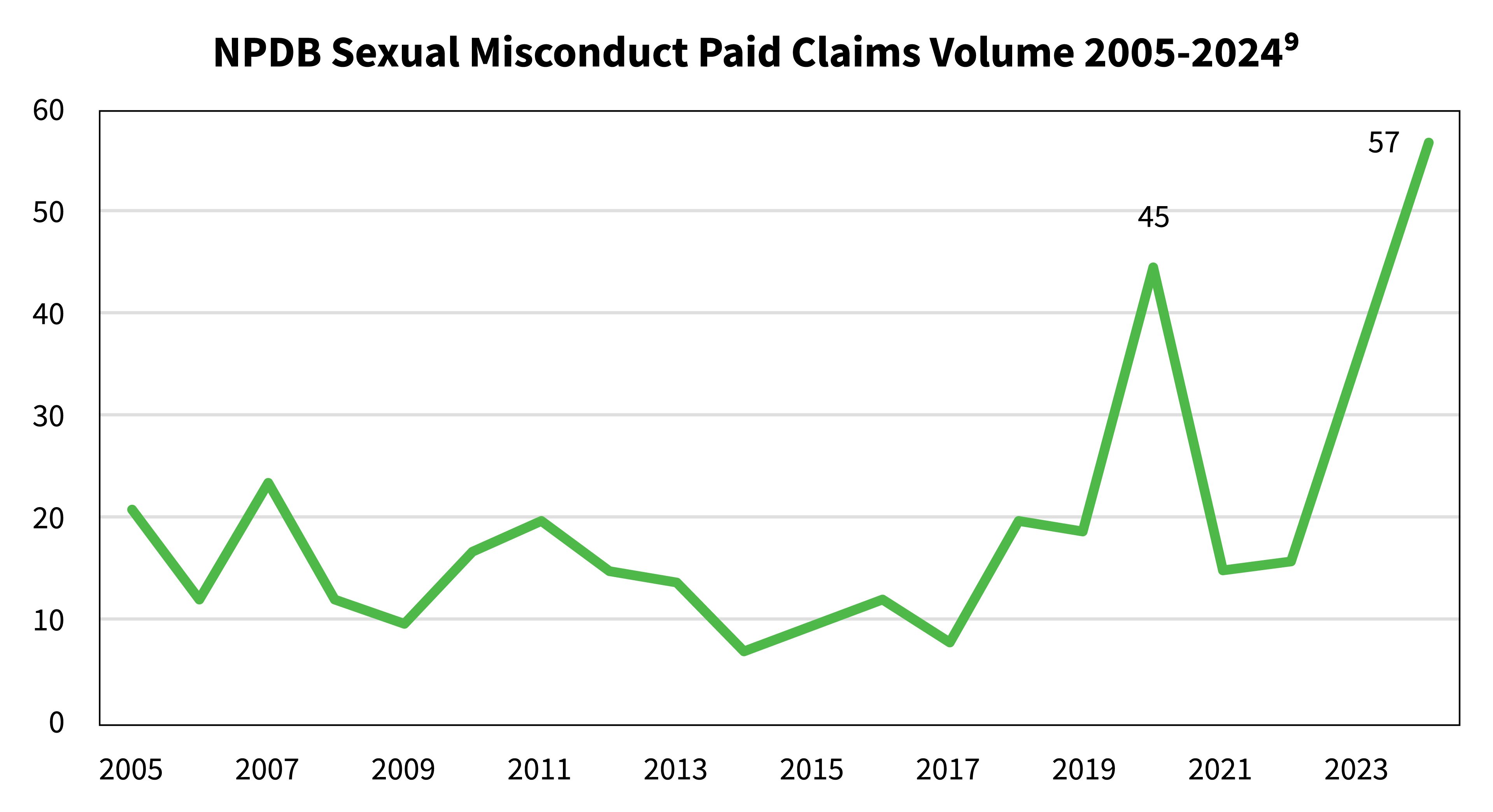
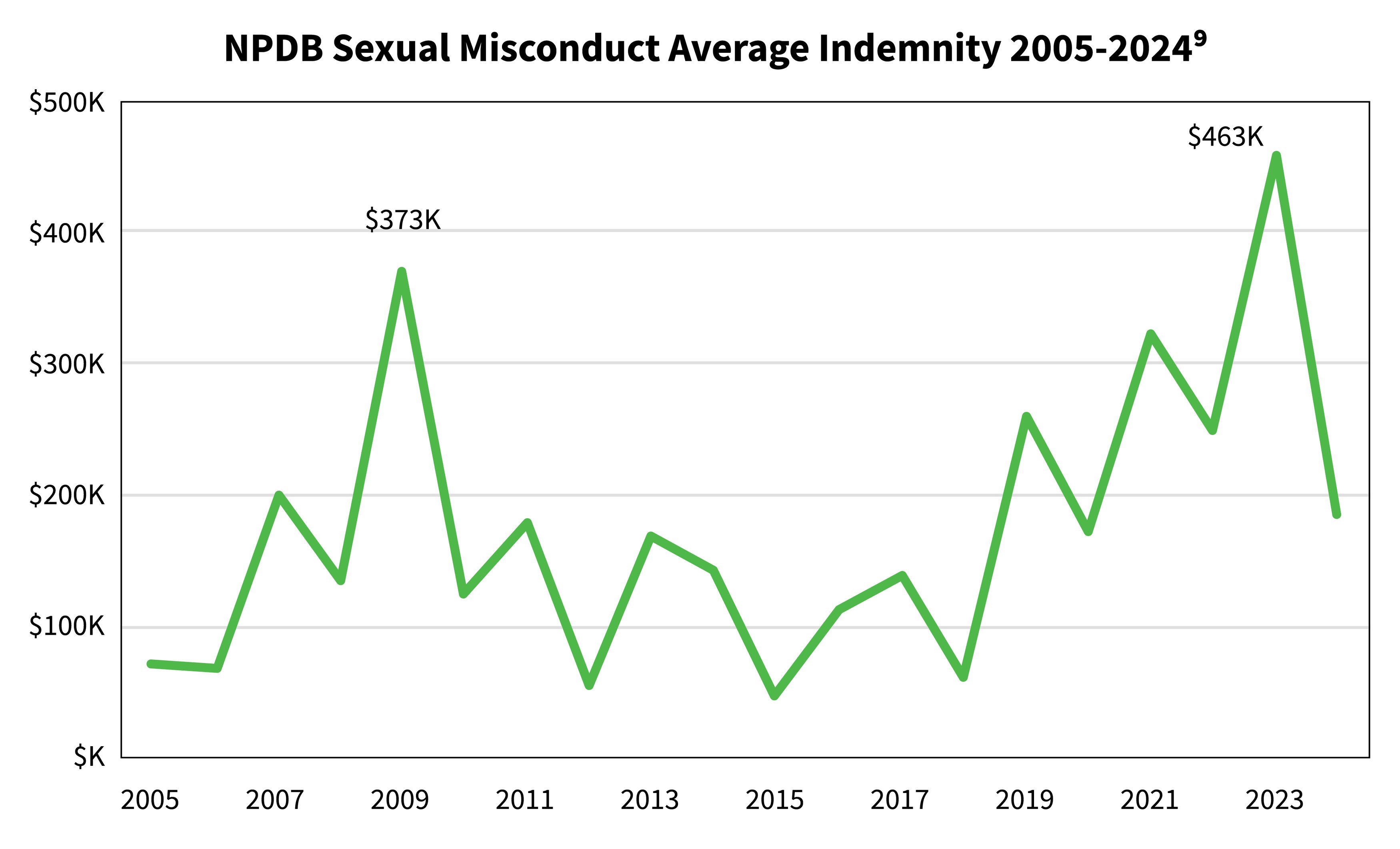
Not only is sexual misconduct by physicians unlawful and unethical—and a common reason for disciplinary action by medical boards—but it can also result in medical malpractice claims. In a study analyzing cases brought to the American Medical Association’s (AMA) Council on Ethical and Judicial Affairs over a five-year period, 12% were categorized as boundary violations, including romantic relationships with patients and sexual contact with patients.7 A national survey of physicians that took place during the same period as Nassar’s egregious acts found that 3.4% of respondents reported having sexual contact with a patient.8 A query from the National Practitioner Data Bank (NPDB) reveals paid claims involving sexual misconduct allegations against physicians have trended upward in the last five years with the highest volume of paid claims in 2024.9 The average indemnity paid for these claims has also increased over this same period.9
 |
 |
In 2020 FSMB expanded its guidelines to address and prevent sexual misconduct by physicians more effectively. These guidelines advocate for culture change across the continuum from medical school to licensed practice, including zero tolerance for harassment of any kind.1 They also bring awareness to the fact that sexual misconduct by physicians is significantly underreported.1 FSMB asks state medical boards to provide clear guidance to the public and health systems about their duty to report complaints in an easily accessible way.1
Communication, patient education, informed consent, and shared decision-making are highlighted in the FSMB’s guidelines as critical elements to meet patient expectations for professional conduct.1 This Claims Rx issue explores clinical encounters in closed claims where physicians fell short of professional conduct expectations and ultimately paid the price.

Professional liability coverage for sexual misconduct claims is limited, as it is usually subject to common exclusions in the policy. As a result of the exclusions, some policies will not pay for damages. In addition, these policies will not be obliged to provide a defense for a suit or claims alleging sexual activity, or acts in furtherance of sexual activity, including when they occur under the guise of professional services. However, some policies will defend such claims with various limitations until the insured is adjudicated to have committed or pleads guilty to the excluded act, at which point the insurer’s involvement ceases.
Insureds should always refer to their particular policy for the specific language and exclusions therein.

 CASE ONE:
Lack of Chaperone Pits Doctor’s Word Against Patient’s
The AMA Code’s opinion on use of chaperones states that “[e]fforts to provide a comfortable and considerate atmosphere for the patient and the physician are part of respecting patients’ dignity.”10 From a risk management standpoint, chaperone use can serve a dual purpose. It can protect patients by discouraging physicians who are tempted to act on sexual feelings, and it can protect physicians from false allegations of sexual misconduct by providing a witness who can testify to a physician’s appropriate behavior. These first two cases illustrate how a claim’s defensibility can be hindered without the proper use of a chaperone, versus strengthened by the presence of a well-trained chaperone.
The medical board investigated these allegations. There was no documentation of an exam involving palpation of the patient’s buttocks. The medical records also did not mention the presence of a chaperone during the exam. The physician denied the allegations and indicated the available medical records showed no reason for him to examine the buttock region. The medical board concluded that there was a lack of evidence to establish the interaction as sexually motivated.
However, a year prior, the medical board received a separate but similar complaint from a patient. In that scenario, there was no chaperone; yet documentation supported the need to palpate the buttocks area in a patient he ultimately diagnosed with coccydynia. Considering two separate complaints, and a lack of a chaperone to testify on behalf of the physician, the medical board ordered the following disciplinary actions:
1. A fine to cover the costs of their investigation.
2. Three hours of medical education on the topic of medical recordkeeping.
3. The presence of a chaperone during any examination of the patient’s intimate parts, whether clothed or unclothed.
4. Documentation of personally informing all patients of his intent to touch intimate parts and giving patients the opportunity to accept or decline.
Notably, the terms of his contractual agreement with a large healthcare plan required his license to be free of material restrictions, which formally limited the physician’s scope of practice. As part of their continuing credentialing process, the plan became aware of the medical board’s sanctions, requiring a chaperone for certain examinations. The plan terminated the doctor’s participation effective immediately. This decision was appealed through an arduous and costly process requiring legal representation and multiple letters of support from professional colleagues.

|
CASE TWO:
|

The hospital completed an internal investigation through peer review. During this process, the physician voluntarily suspended his privileges at the hospital. At the investigation’s completion, the hospital restored the physician’s privileges.
At deposition the patient stated that the physician placed his stethoscope under her gown with ungloved hands and groped her breasts during the heart and lung exam. She explained that other doctors in the ED completed this exam over the top of her gown. The patient also stated the physician examined her abdomen beneath her gown; she felt there was no need to press so low at the level of her pubic hairline. It was brought to her attention that EMS documented suprapubic pain in their report. She stated that she didn’t know what that word meant, but that she was having lower abdominal pain.
The patient, nurse chaperone, and physician all had a similar recount of the events during the pelvic exam—there was always a chaperone present and the exam elicited pain. The nurse’s documentation supported her presence throughout the exam. It noted that when additional supplies were needed, the nurse stayed in the room and called the unit clerk for delivery. Further, the nurse stated that she had been present as a chaperone for multiple pelvic exams with this physician and had never noticed anything out of the ordinary or concerning.
A defense expert supported the physician’s care. In addition, he stated that performing a heart, lung, and abdominal examination under the gown is completely appropriate. He also opined that the pelvic examination was appropriate and expected to elicit pain with her history of recently taking an emergency contraceptive.
With positive support from the nurse chaperone, thorough documentation, and positive expert testimony, defense counsel filed a motion for summary judgement in favor of the physician. The judge granted the motion, which ended the case.
 |
Requiring a chaperone during sensitive medical exams and offering a chaperone for any exam when requested by a patient helps to protect patient dignity and supports patient modesty. Consider the following strategies to reduce the risks of false allegations of sexual misconduct:
|
ADDITIONAL RESOURCES
University of Michigan Health: A Patient’s Guide to Sensitve Health Exams and Procedures
Overview of sensitive exams and procedures
Yale Health: Medical Chaperones for Sensitive Examinations, Treatments and Procedures
Patient education outlining chaperone policies and procedures
Vanderbilt University Medical Center: Medical Chaperone Policy
Sample chaperone policy and procedure

CASE THREE:
Procedural Touch Misunderstandings
Chaperone use is only one aspect of guarding against sexual misconduct allegations. The importance of educating patients about “procedural touching” and creating a comfortable and respectful patient environment—particularly for examinations that are sensitive or intimate—cannot be overstated. Physicians cannot assume patients understand the necessity, location, and extent of procedural touch. Allegations of sexual misconduct often involve patient misunderstanding of procedural touch as exemplified in the following case.
During pretrial testimony, the physician, medical assistant, and patient differed in their recollections of that day’s events. The physician testified he informed the patient he planned to include a vaginal exam prior to touching her and that he would go through the exam step-by-step, inviting her to tell him to stop if at any point she was uncomfortable. He also recalled the patient being covered with a drape. Both the medical assistant and patient testified that a vaginal exam was not discussed prior to the patient being touched, and that the patient was not covered with a drape. The medical record did not provide evidence to support the physician’s recollection of events.
The plaintiff’s expert opined that it is well within the standard of care to include a vaginal exam as part of the anal and rectal exams in a female complaining of rectal pain. However, the expert noted the physician breached the standard of care when he did not gain explicit consent from the patient to perform each step of the exam. Multiple defense experts opined that the physician met the standard of care by explaining all planned steps and using a female chaperone during the examination.
Ultimately the case was settled, which triggered two separate obligations. First, the medical malpractice carrier had a duty to report the settlement to the NPDB. Those authorized to query the NPDB, such as state licensing boards and hospitals, can view the information in this report (e.g., settlement amount, treatment performed, allegations, and injuries). Second, in this state, the settlement triggered an obligation for the physician to self-report to the state medical board within 30 days.
|
A formal consent process is imperative prior to procedural touch in sensitive areas. While there may be a reasonable explanation for extending procedural touch to adjacent sensitive areas, patients must clearly understand this reasoning and give consent prior to being touched in these additional areas. Additionally, taking proactive measures to ensure comfort before starting an exam can reduce interruptions, necessitating added procedural touching. All patients differ in their sensitivity, expectations, and anatomical understanding. Consider the following risk reduction strategies to avoid procedural touch misunderstandings:
|
ADDITIONAL RESOURCE
Medical Board of California: Touch and the Practice of Medicine
Considerations to enhance trust and minimize confusion

CASE FOUR:
Sexual Exploitation During Psychotherapy
The AMA Code’s opinion on professional self-regulation states “[r]omantic or sexual interactions detract from the goals of the patient-physician relationship and may exploit the vulnerability of the patient, compromise the physician’s ability to make objective judgments about the patient’s healthcare, and ultimately be detrimental to the patient’s well-being.”11
The American Psychiatric Association (APA) further interprets the AMA Code’s principles with annotations to provide guidance specifically in the context of psychiatry.12 Highlighting the highly personal and sometimes intensely emotional nature of the psychiatrist-patient relationship, the APA prohibits psychiatrists from exploiting the patient to gratify their own needs; psychiatrists must ensure their conduct does not harm patient-physician boundaries.13 The following case exemplifies how boundary crossing can lead to dire consequences for psychiatrists and threaten patient safety.
The psychiatrist’s acts in this case were a clear violation of the AMA Code, which prohibits romantic or sexual relationships with patients. They were also a clear violation of his state medical board’s policy on medical practitioners and sexual misconduct, which strictly prohibited physicians from sexual relations with patients. Further, when sexual exploitation is determined during any medical board prosecution, the law required the physician’s license to be revoked. In this state, any sexual contact with a patient is considered sexual exploitation.
The state law also allowed former patients to sue psychotherapists for injuries caused by sexual contact if the contact occurred during the therapy period, within two years following termination of therapy, or by means of therapeutic deception.
During discovery and the deposition process, medical record documentation was inconsistent with the patient’s recollection of events and emails produced into evidence. Medical records indicated the physician declined an intimate relationship with the patient and reset boundary expectations with her. Meanwhile, the patient testified that the physician ordered an affair as part of therapy. Emails from the physician reflected expressions of his love and desires for the patient. Additionally, he admitted to being in a sexual relationship with the patient.
In the process of obtaining defense experts, the state regulatory board hearing took place. At this hearing the physician voluntarily surrendered his medical license. The defense team and physician subsequently determined that the medical malpractice case needed to be settled with payment to the patient.
|
Data suggests that boundary violations among physicians, particularly those involving sexual relationships with patients, are more prevalent among certain groups. Male doctors between the ages of 40 and 49—especially those in psychiatry, family medicine, and obstetrics/gynecology—are at higher risk for these violations.14, 15, 16 It is imperative that clinicians are aware of their own behaviors and remain vigilant of patient behaviors to prevent boundary misunderstandings or violations. Consider the following risk reduction strategies:17, 18
|
ADDITIONAL RESOURCES
AMA Ed Hub: Sexual and Romantic Boundary Violations
CME course for clinicians about boundaries and how to avoid boundary violations
FSMB: Professional Boundaries Educational Series
Scenario-based video CME that highlights the importance of maintaining professionalism and ethical standards in all professional interactions

